
Trial by Bookshelf
The Return of a Very Bad Idea | HJL Books #9

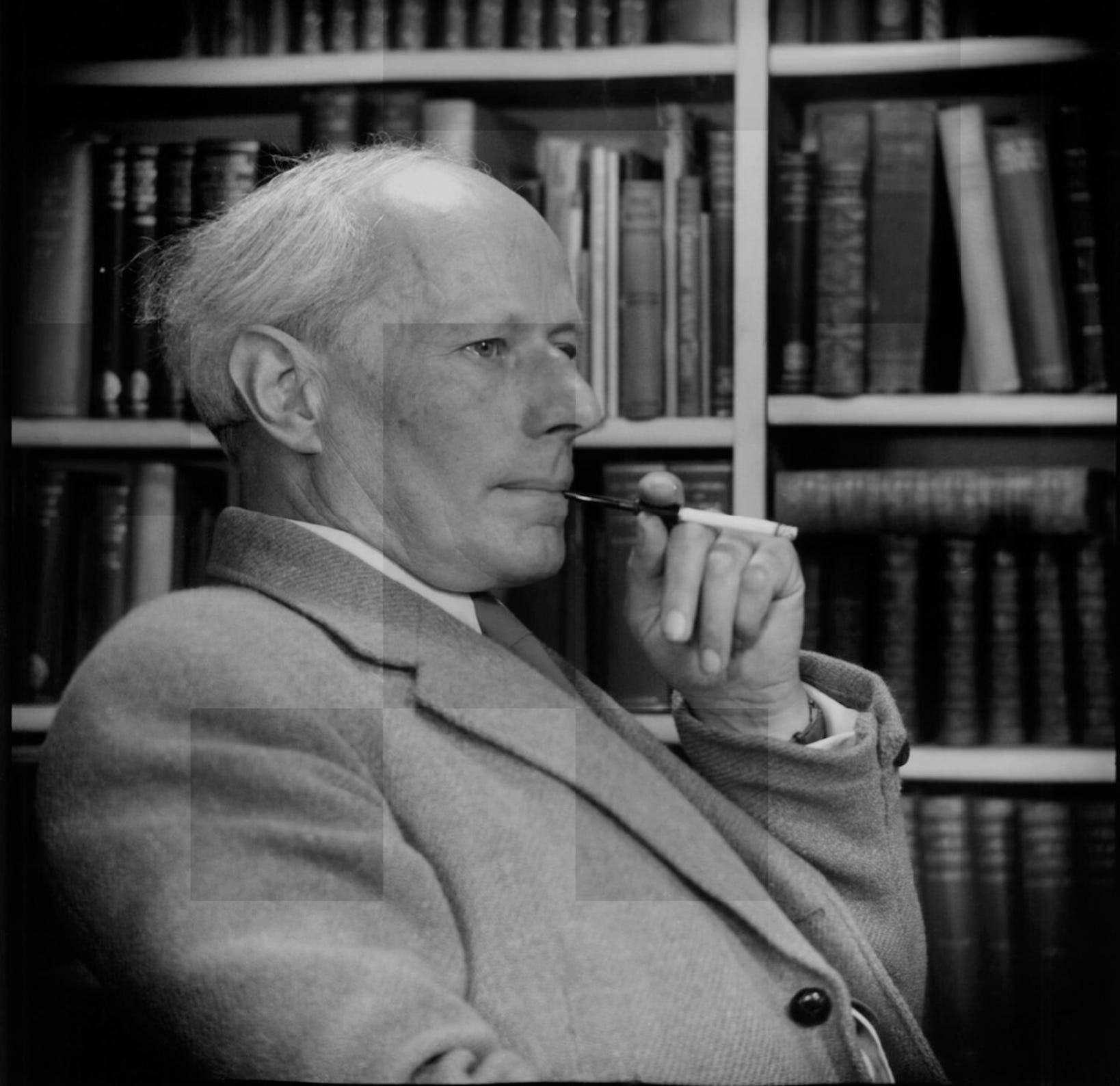
The Accused
An eerie principle has re-emerged in public life: that a person may be judged not by what he has said or done, but by what sits on his bookshelf. In the latest example, a public official has been driven from his position in Niagara Falls, Canada because of a book he owned. Not because he wrote it, endorsed it, made a shrine from it, prayed over it, promoted it—but simply because he owns it (and had the gall to have it insured). And no, it wasn’t Common Ground by Justin Trudeau.
Yes, as you will have seen from the referenced article, it is that book. And, all told, I am glad for it to be. Precisely because it is this book, the argument against treating private libraries into instruments of judgment can be made in its strongest form. One can defend the ownership of any other title and still be met with the inevitable objection: “Even HITLER?”1 Yes—even Hitler. Indeed, as I will come to suggest, perhaps especially Hitler.
Opening Statements
My first response to this story is that Gale made a heck of a buy, at least monetarily speaking. He apparently paid $6,345 (I believe this would be USD) for the book in December 2010. I cannot find the exact copy that Gale bought, nor a fuller archive of the sale, which is not helped by the fact that the auction house, National Book Auctions, has since gone out of business. But I believe it is an early German edition; a Toronto Star article cites the book in the appraisal (which valued the book at $16,000 CAD) as being in red cloth boards, which is consistent with that theory.
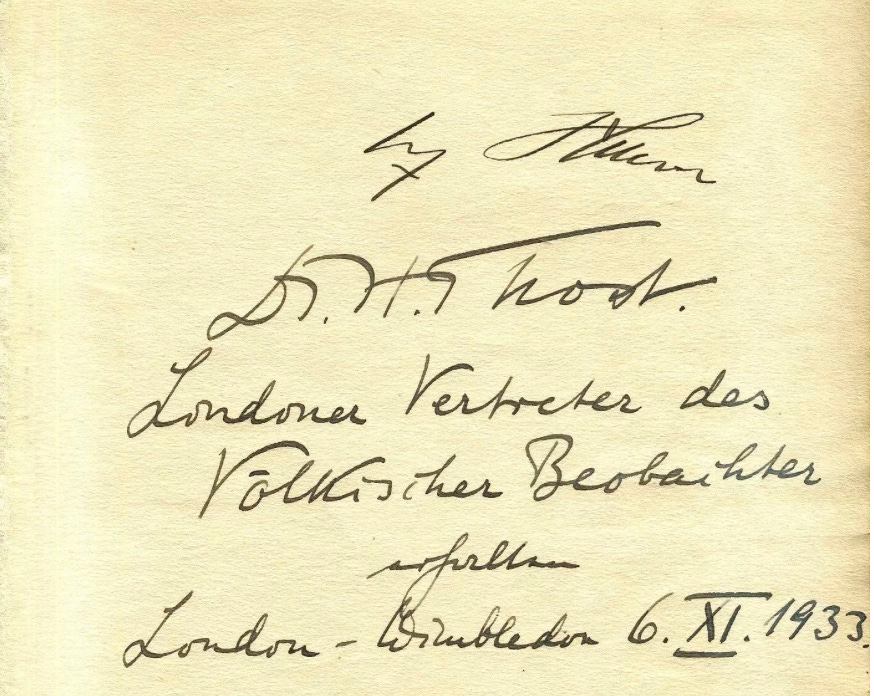
So why was it such a good buy? Well, the last copy I have seen of a book signed by Hitler sold for 42,000 Euros in December 2025. Granted, it was a signed copy of the infamous 1933 abridged English edition, which also had the ‘credit’ of being owned by one Dr. Hans Wilhelm Thost, a London correspondent of the official Nazi newspaper Volkischer Beobachter, who was also intricately involved in the publication of the edition2. Another signed copy of a German edition brought in 17,000 Pounds in 2017. Already Gale’s book was appraised for $16,000 (presumably, CAD) in 2018. I think it could sell at an auction today for double that. So, a tip of the cap to Gale.
Now that I have tipped my hat to Gale, I mean to do whatever the opposite action is to the rest of the characters in this story, who attempt to revert to a ridiculous precedent we had, until recently, seemed to have outgrown. For, such accusations being levied at Gale and rely on a crude and deficient assumption that the possession of a book implies the endorsement of its contents, and are further underwritten by a willingness to destroy books outright: “Gale should now destroy his signed copy of Mein Kampf because it belongs in the garbage, just like the Nazi hate of those that promote it.” Burn.
If such a standard were applied consistently, every decent historian in the world would soon find themselves under suspicion, standing accused by the contents of their library. Books and other artifacts do not become less historically important or worthwhile because they are morally repellent. Conservators often preserve the most uncomfortable remains of the past—this is what they should be preserving. Libraries hold propaganda produced by dictators and dictatorships—this is what they should be holding. Archives maintain the manifestos of revolutionaries and extremists—this is what they should be maintaining. And this responsibility should not rest with institutions alone.
What casts (an illuminating) shadow on the situation is that the quoted critics appear confused about what they are objecting to: the mere possession of the book, as in statements like “It’s shocking but not surprising that Niagara’s highest elected municipal official owns hate literature” or “Gale needs to explain himself publicly and apologize for owning one of the most notorious pieces of antisemitic hate,” or the specific signed copy, as in “[it is] untenable for any official, let alone the top politician, to hold on to [the] signed book.”3 That they do not—or cannot—distinguish between these two matters exposes the faultiness and spuriousness of their protest.
The English Publishing History of Mein Kampf
The attempted suppression of Mein Kampf is largely a repetition of a historical oversight. For, the tragedy of Mein Kampf is not that it was read by too many people, but too few. Hitler’s manifesto appeared in Germany in two volumes, in 1925 and 1926, yet it remained largely inaccessible to English-speaking readers for over a decade. Only a heavily abridged edition, “The Dugdale Abridgement,” was published in English in October 1933, selling 89,390 copies in the UK—though over 60% of these were sold in 1938. But most Western observers dismissed it as incoherent ranting and many policymakers ignored or trivialized it. There is no evidence that Stanley Baldwin or Neville Chamberlain ever read even this abridgement.
Who was most responsible for the English expurgation of Mein Kampf remains a matter of debate. Was the text dampened to cause less offence, with influence from the publisher? Was it erroneously trimmed during the abridgement process, or mistranslated in the first place by Dugsdale? Or were parts deliberately cut by Hitler and the Nazis in order to obscure their true intent? It is likely some combination of all three influences.
Franklin D. Roosevelt had a copy of the abridgement (which was also published in the US in 1933) in his library, annotated as follows, “The White House – 1933 / This translation is so expurgated as to give a wholly false view of what Hitler is and says – the German original would make a different story.”
It did tell a different story, or at least a more detailed one. Mein Kampf, in its ‘German original’,4 clearly laid out Hitler’s worldview and plans for the future: expansionism, antisemitism, racial struggle. It might as well have had the subtitle: What I’m Going to Do and How I’m Going to Do It. Finally, a complete English translation appeared in the UK on March 20, 1939, and in the US in two competing editions on February 28, 1939. By then, however, it was too little, too late: the work had already exercised its influence largely beyond the reach of informed scrutiny. Mein Kampf was insufficiently read, and just as insufficiently confronted.
Some diplomats and journalists, however, did read Mein Kampf seriously, even seeking out the original German, as Roosevelt hinted. They were not deterred by its danger, but drawn to it; not offended by its offence, but alarmed by its implications. Sadly, many of their warnings fell on deaf ears—or on those who simply did not wish to listen. Several of these figures are discussed in my latest catalogue: Google Drive or Website.


In the preface to his work, Germany Unmasked (London: Martin Hopkinson, 1934), Dell argues that the significant abridgement (by two-thirds) of Mein Kampf was an attempt by the Germans to “dupe the English speaking public,” citing many examples of where Hitler’s domineering language has been obscured, changed, or entirely left out. “But there is an abridgement and abridgement…such a reduction exceeds the limits of an abridgement capable of giving any real idea of the original book.” From his knowledge of the original German, Dell would remark “Hitler’s whole foreign policy since he came into power has been in accordance with the principles of Mein Kampf.”
Journal Under the Terror 1938 (London: Cassell, 1939) is the contemporaneous diary of the classical scholar and critic F.L. Lucas, written during the political crisis of 1938 and published on the eve of the war. Having read Mein Kampf in the unexpurgated original and taken its threats as a statement of intent, he urged in September 1933 that Nazi Germany be prevented from re-arming. He would later serve at Bletchley Park and be commended for his premonition that Hitler would sever ties with Stalin and invade the Soviet Union (despite his claims that the plan was simply set out by Hitler in Mein Kampf).
Dell further invokes the book in reflecting on Chamberlain’s return from Munich:
“And he waves a piece of paper with Herr Hitler’s signature—the signature of that hand which has sent to death, or to torture worse than death, so many innocent men and women, so many comrades of his own; the hand that has written one of the vilest and cruellest books in history. But Mein Kampf is forgotten: its menaces, so many of them already fulfilled, it would be too comfortless to remember on this day of days.”
Finally, Emily Lorimer was an Irish-English journalist, linguist, and political commentator. Her book, What Hitler Wants (London: Penguin, 1939) was a prophetic, step by step guide to the aims and threats which Hitler had simply set out in the original German edition of Mein Kampf.
All of these commentators were aided by the text, not harmed by possessing it. Yet Gale’s critics seem to object to the reading of the book itself. But can anyone really argue that a deeper understanding of World War Two would not be strengthened by reading Mein Kampf? The purpose of reading is not to confine ourselves to works we already agree with. We are not better served by banning books than by owning—and, crucially, reading—them. Collecting should be encouraged, not demonized.
Closing Statements
If more people had read Mein Kampf, the threat of Hitler and Nazi Germany might have been confronted earlier—or at the very least understood and addressed differently. Greater engagement with the text could have alerted policymakers, diplomats, and the public to the true scale of Hitler’s ambitions, the ideological foundations of his antisemitism, and the expansionist aims that would later plunge Europe into war. By leaving the book unread—or relying only on abridged, expurgated versions—Western leaders and societies were denied a clear warning, and the opportunity for informed, preemptive action was lost. Which is why I have no sympathy for those that wish for it to once again be censored, nor for other controversial texts to be banned.
A free society depends on the freedom to read and study even the worst ideas—and perhaps depends even more on understanding the most dangerous ones. The alternative is a culture in which books are treated as potential contraband rather than as historical records or educational material. A society confident in its values does not fear books; it welcomes them, seeks out challenges to its most fundamental assumptions, and refuses to presume that the populace requires protection from offensive material—or to negatively judge people by the books they own.
In Germany, the first full reprint of Mein Kampf since the Second World War was published in 2017. After the fact, the publisher responded to whose who were critical of the edition as follows:
“It turned out that the fear the publication would promote Hitler’s ideology or even make it socially acceptable and give neo-Nazis a new propaganda platform was totally unfounded. To the contrary, the debate about Hitler’s world view and his approach to propaganda offered a chance to look at the causes and consequences of totalitarian ideologies.”
The only totalitarian tendencies here are on the side of those who forced Gale’s resignation. To that end, I might offer these aspiring censors a copy of my latest catalogue, where they could read more about Lucas, Dell, and Lorimer—others who read the book, others who did not—and begin to understand the consequences of refusing to engage with controversial texts and ideas. On second thought, they already embody those lessons perfectly. I commend Gale for keeping the book rather than the job. But he should have been able to have both.
The irony is that there are much more objectionable books. But the Hitler response falls under a certain Hitler/Nazi, where the allusion to one or the other is brought up to end any debate. For instance, some recent books I am handling: The Revolt Against Civilization by Lothrop Stoddard, Racial Elements of European History by Hans F.K. Günther.
It was Thost who Thost who insisted on taking a draft of what would become the 1933 abridgement to Berlin for further censoring and official sanction.
A stronger argument might have been that they would support (and even encourage!) the ownership of the book, which may be educational, but not a signed copy of the book, which hardly adds any additional educational slant. Gale could then explain why he owns a signed copy, but not have to deal with such drivel as defending his ownership of a so called “notorious piece of antisemitic hate.”
Of course, the same version being suppressed here. Seems important!
FWIW, here's the listing:
https://www.invaluable.com/auction-lot/adolf-hitler-mein-kampf-1927-inscribed-first-prin-2225-c-f403ac1442?objectID=63850198&algIndex=undefined&queryID=5bdda2c7925fb11996c0b3ca98980523
Lot 2225: Adolf Hitler MEIN KAMPF 1927 Inscribed First Printing Die Nationalsozialistische Bewegung
Publisher: Berlag Franz Eher Nachfolger
Printing Year: 1927
Condition/Details: This unique 1927 first printing of the second volume of Mein Kampf is bound in crimson cloth with gilded full page edges and bright gilt embossing on the front board and spine. The book is inscribed in blue ink on the front free endpaper, at Christmastime in 1926 by Adolf Hitler to his close friend and resident German priest at the church he then frequented in the Munich area. Signed editions of Mein Kampf are very rare and particularly difficult to find with a dedicated inscription.
This copy is affectionately inscribed to Max Sauerteig who was married to Maria Sauerteig and served as clergyman in a Munich area church during the first part of the twentieth century. Adolf Hitler was a known face in the Sauerteig home as he was a frequent visitor. This book has been consigned to us by the great granddaughter of Max Sauerteig and we have copies of government documents which establish her lineage back to the Sauerteig name. Our client's father (grandson of Max Sauerteig) served in the SS during the war. The book was recently discovered in the attic of the family home in Munich, which has been vacant for the past several decades.
Mein Kampf was the political manifesto written by Adolf Hitler. It was his only complete book and became the scripture of National Socialism (Nazism) in Germany's Third Reich. It was published in two volumes in 1925 and 1927, and an abridged edition appeared in 1930. This second volume, entitled Die Nationalsozialistische Bewegung (The National Socialist Movement), was written after Hitler's release from prison in December. The volume outlines the political program, including the terrorist methods, which National Socialism was to pursue both in gaining power and in exercising it thereafter in the new Germany. (history courtesy of Encyclopedia Britannica)
The volume shows well with some external age/wear including sunning and rubbing at the extremities. It is solidly bound with clean pages, no other writing or markings are present. The book measures approximately 6.5" x 9.25" and contains 354 pages.
PLEASE NOTE: Due to international law concerning Nazi-related materials, we are only able to ship this item to U.S. addresses. Shipping charges will be dependent upon destination and insurance coverage based upon ultimate hammer price. If you prefer to arrange your own shipping, we will be pleased to work with your carrier.